How to set up a sports club in Spain: requirements and steps
A guide to setting up a sports club in Spain: which legal form to choose, the requirements and steps to constitute it, the statutes, and how to fund it from day one.
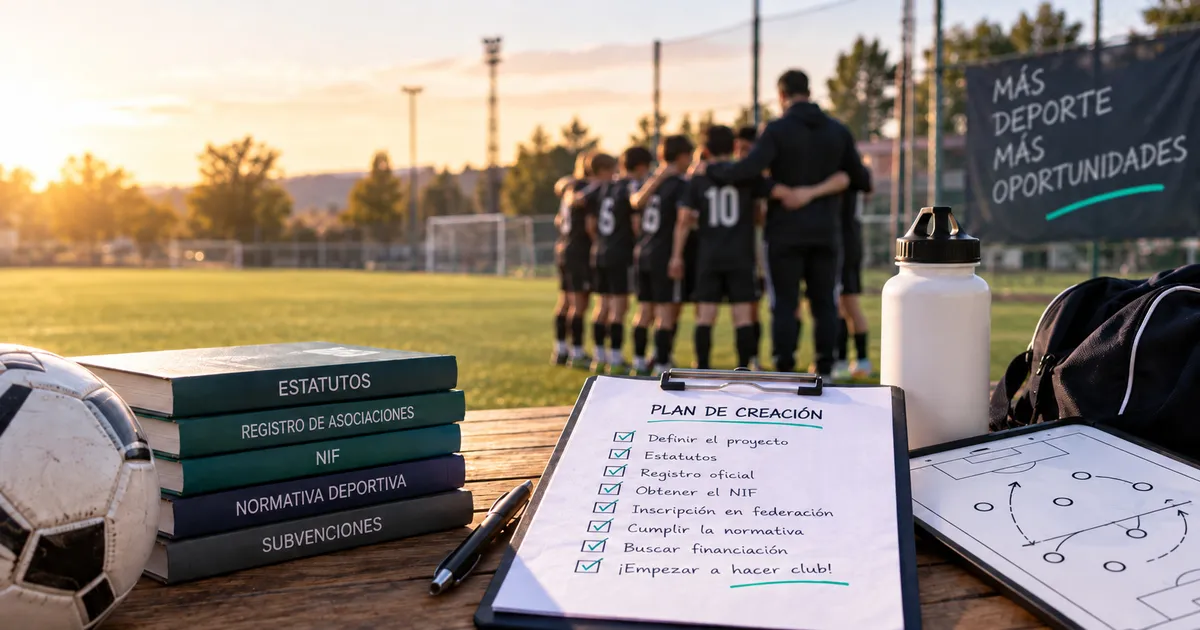
A group of friends who already train together every week, some parents who want their kids to compete properly, a coach with an idea. At some point the same sentence comes up: we should make this official and start a club.
Setting up a sports club in Spain is simpler than it looks, but it has its steps and its paperwork. This guide covers which legal form suits you, the requirements and steps to constitute it, what the statutes must say, and the part almost nobody warns you about: how to fund the club from the very first day.
Which legal form to choose
First, decide what you’re actually creating, because they aren’t the same. These are the usual forms, and the choice shapes the paperwork and the obligations:
| Legal form | What it is | Best for |
|---|---|---|
| Elementary sports club | The simplest form, for the direct participation of its members | Small groups wanting minimal paperwork |
| Basic sports club | A non-profit sports association with its own legal personality | Most grassroots and neighbourhood clubs |
| General association | An association under the Associations Act, not specifically sporting | Non-competitive or mixed activity |
| Sports public limited company (SAD) | A commercial company, with capital and profit motive | Professional clubs |
For a grassroots club, the usual choice is a sports club, that is, a non-profit sports association with legal personality. The SAD is a matter for professional sport and is a long way from here. Note that the exact categories (elementary, basic) and their names vary by autonomous community, so check the ones in yours.
Requirements to set up a sports club
The requirements to create a club are few, though the detail changes from one community to another:
- A group of founding members. The minimum varies by autonomous community (usually three or more individuals with legal capacity). It’s the first thing to check in your region’s registry.
- A sporting purpose. The club is constituted to practise or promote one or more disciplines. That purpose goes in the statutes.
- Non-profit. Any surplus is reinvested in the club, not shared out. That’s what unlocks the advantages of a non-profit entity.
- A registered address. A reference address for the club, which can be the premises, the ground or an officer’s address.
Steps to set up a sports club
With the form chosen, these are the steps to create a sports club. The national framework is the Sports Act (Ley 39/2022), although registration is handled at regional level:
- Draft the founding charter. The document that certifies the creation of the club, signed by all the founding members. In most cases a private document is enough, though some communities may ask for extra requirements.
- Approve the statutes. The club’s internal rulebook. What they must contain is just below.
- Register the club in your autonomous community’s Register of Sports Entities. This is the step that gives it official existence. Each community has its own registry and procedure.
- Apply for the tax ID (CIF) at the tax office. The club’s fiscal identification number, needed to open a bank account, issue receipts and operate.
- Appoint the board. At minimum a chair, a secretary and a treasurer. These are the people who represent and run the club.
- Affiliate to a federation if you’ll compete. To play official competition, the club has to register with the regional federation for your sport.
Setting up a football club follows exactly these steps, with your region’s football federation as the last rung before you can enter teams in a league.
The statutes: what they must include
A sports club’s statutes are its internal rulebook, and the registry reviews them before registering the club. They don’t need to be convoluted, but they must cover these points. Use this list as a template:
- Name and registered address of the club.
- Purpose and sporting disciplines it will practise or promote.
- Governing bodies (general assembly, board) and how they’re elected and renewed.
- Membership rules: how you join, how you leave, and what rights and duties members have.
- Financial rules: assets, annual budget and how the accounts are approved.
- Dissolution: what happens to the assets if the club ceases to exist (in a non-profit, they usually go to another sporting or social purpose).
A practical tip: many communities publish a model set of statutes on their registry website. Start from that and adapt it, rather than writing from scratch.
What nobody tells you: the club is born with no money
Here’s the part the paperwork guides skip. The day the registry signs you off, the club exists, and with it come its costs: licences, insurance, gear, pitch hire, referees, travel. Income, for now, is zero.
The paperwork has an end. The club’s costs don’t. That’s why the real question isn’t how to create it, but how to sustain it.
Constituting the club is the formality. Funding it is what decides whether it’s still alive in three seasons. It’s worth having the funding plan thought out before the first registration. The realistic routes for a new club are:
- Cashback, the baseline that doesn’t depend on anyone. When the club’s families do their everyday shopping at a partner store through Esportik, the store pays a commission that comes back directed to the club, at the same price and no extra cost. We explain it in what is cashback, and how it adds up in support your club.
- Local sponsorship, to add income in exchange for visibility. The method is in sports sponsorship.
- Events and campaigns for specific spikes, with the upsides and limits we cover in alternatives to raffles.
You can see which costs each route covers in what can be financed.
Frequently asked questions
How many people are needed to set up a sports club? It depends on your autonomous community. The usual minimum is three or more individuals with legal capacity, but some regions ask for more. Confirm it in your community’s registry before you start.
What’s the difference between a sports club and an association? A sports club is registered in the Register of Sports Entities and governed by sports regulation, built for activity and competition. A general association is governed by the Associations Act. To compete in a federation, the right form is usually the sports club.
Do you need to affiliate to a federation? Only if you’re going to play official competition. For training or an internal activity, a constituted and registered club is enough.
Start with the full plan
Creating the club is the part that a list of steps and some patience with paperwork will solve. Sustaining it is the part you solve by starting early, before the first bills arrive.
Create your club’s profile among the available profiles and start building its funding base from day one, so the newborn club has something to grow on.