Alternatives to raffles for funding your sports club
The best alternatives to raffles for fundraising for a sports club: why raffles wear thin, and how cashback raises a steady baseline without asking for anything.
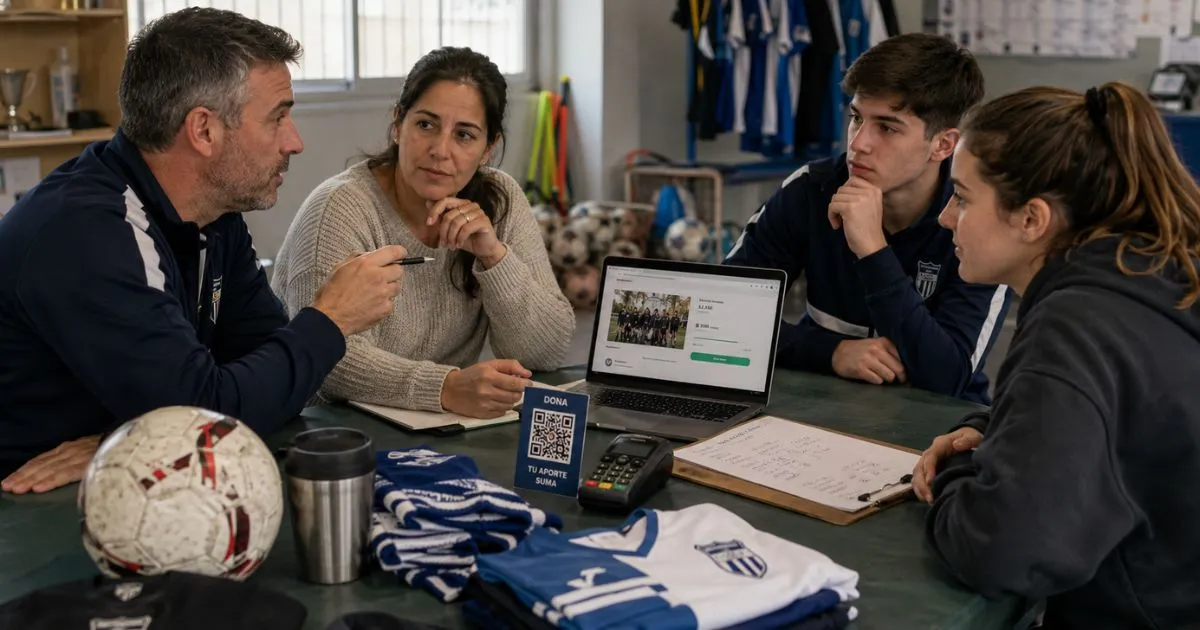
Every season the same moment arrives: the club needs to raise money for travel, kit or the end-of-year tournament, and someone suggests the usual thing. A raffle. Printed ticket books, strips handed round to families who’ve run out of people to sell them to, and a prize you have to talk some local sponsor into donating.
Raffles work, but they wear thin. If you’re looking for alternatives to raffles for your club, that’s exactly what this article is about: why the raffle has the ceiling it has, what real options exist, and which one raises a baseline without asking anyone for a penny extra.
Why raffles wear thin (even when they work)
Raffles for fundraising are a grassroots classic for a reason: they raise real money and everyone understands them. But they have three limits that anyone who has run one will recognise.
- They’re manual work, and it runs out. Print, hand out, chase the money, draw the winner. Every raffle starts from zero and leans on the same four families pulling the weight one more year.
- They hit the same people every time. Sports raffles end up sold to parents, grandparents and neighbours: the same circle, over and over, until it’s saturated and the unsold strips sit in a drawer.
- They give a spike, not a baseline. A football raffle covers one one-off cost and it’s done. Next month, with the next bill, you start again.
None of this makes them bad. For a specific, urgent cost, a well-run raffle is still a useful tool. The problem isn’t running a raffle: it’s relying on them alone to hold up a whole club.
Alternatives to raffles that actually raise money
Before the one we think is best, here’s the honest map of sports team fundraising ideas, each with its upside and its catch:
- Charity events. A benefit tournament, a shared meal, an open day. They raise well and pull the club together, but they demand a huge amount of organising and a full weekend of volunteer work.
- Local sponsorship. The café, the hardware shop, the local clinic in exchange for their name on the shirt. It’s the steadiest route of all, but it depends on businesses with thin margins and on someone keeping the relationship alive year after year. How to work this route is in sports sponsorship.
- Crowdfunding with a goal and a deadline. For a big, specific cost — a trip, work on the pitch — a one-off campaign works well. We cover it in full in sports crowdfunding: it’s built for the spike, not the day to day.
- Higher subs. The quickest option and the one that sits worst, because it loads the cost onto the family least able to carry it. It’s usually the exact thing that leaves a kid out.
None of these is wrong in itself. But notice the pattern: nearly all of them ask for something — time, money or a favour — and nearly all of them run out. What’s missing is one that raises money on its own, in the background, without asking.
The alternative that raises a baseline: cashback
Here’s the difference. The most sustainable way to do fundraising for a sports club isn’t running one more event or putting subs up, it’s tapping a cost families already have anyway: their everyday shopping.
It works like this. When a club family shops at a partner store through Esportik — the supermarket, clothes, gifts, whatever it is — the store pays a commission, and that commission comes back as cashback directed to the club. Same price, same purchase, no extra cost. We explain it step by step in what is cashback.
A raffle gives you one good Saturday. Cashback gives you every month, without selling a single ticket.
And the maths adds up precisely because it doesn’t depend on a one-off push but on a steady trickle. Thirty families shopping as usual raise far more than it sounds across a season, as we break down in support your club. It won’t replace an express raffle this Saturday — that has to be said — but it builds the baseline that means the next raffle isn’t even needed.
Is there a FlipGive alternative in Spain?
Yes. FlipGive is the sports cashback platform that’s hugely popular in the United States and Canada, where thousands of teams fund their season through their families’ everyday shopping. Its equivalent for clubs and athletes in Spain is Esportik: the same underlying idea — day-to-day purchases generate a commission that goes to the club or the player — adapted to the Spanish market, with local stores and fundraising in euros.
The main difference isn’t the model, which is the same, but the roster of stores and the focus: Esportik works with retailers operating in Spain and lets you direct the cashback to a club or to an individual athlete. If you knew FlipGive and were looking for something like it on this side of the Atlantic, this is it.
How to start
Moving from the raffle to a steady baseline takes a few minutes:
- Create or choose the club’s profile on Esportik.
- Get the families going. Ten or fifteen shopping as usual through the platform already moves the needle.
- Let the cashback build up month by month, with no events and no tickets.
- Keep raffles for what they’re good at: a one-off spike, not the club’s backbone.
For the full picture of funding routes, see ways to finance a football career, and the detail of which costs each one covers in what can be financed.
Choose your club or create its profile among the available profiles and start building the fund today, so that next year the raffle is an option, not an obligation.