How much does it cost to run a sports club
How much it costs to run a sports club over a season: a real grassroots budget, the fixed costs that choke a club, and where the income comes from.
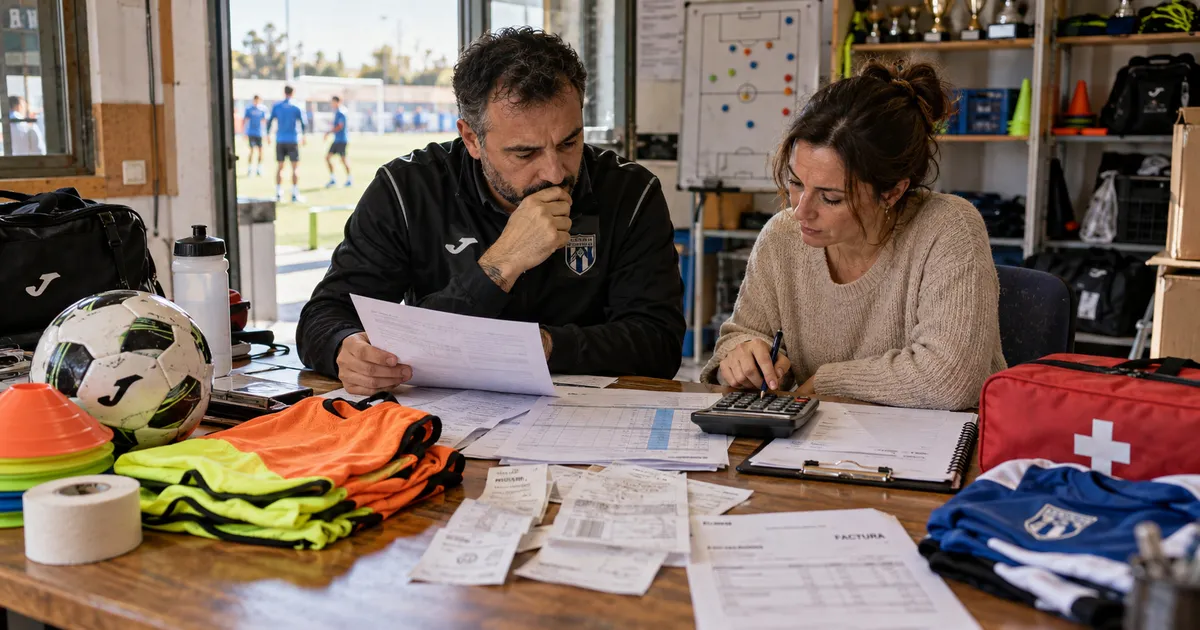
The club exists, the teams are registered and the first match is on Saturday. Then, with the season already rolling, comes the question nobody asked while the paperwork was being filled in: how does this get paid for, month after month?
This article answers how much it costs to run a sports club at grassroots level across a season, with a broken-down budget and a worked example. It isn’t the bill for setting one up, that’s covered in how to set up a sports club. It’s the other thing, the one that never ends: the cost of keeping the club alive every next month.
What a sports club budget is made of
Before the figures, it helps to see the pieces. A grassroots sports club budget almost always splits into these headings:
| Heading | What it covers | How it behaves |
|---|---|---|
| Licences and registrations | Each player’s and coach’s federation licence | Fixed per season, per person |
| Insurance and medical cover | Compulsory sports insurance, medical cover | Fixed per season |
| Match officials | Paying referees in official competition | Variable, per match |
| Facility | Pitch hire or use, lighting, upkeep | Fixed monthly or per use |
| Equipment | Balls, kit, cones, first-aid kit | Mixed: big spend up front, then top-ups |
| Travel | Coach or cars to away matches | Variable, per round |
The first lesson is in that last column. Part of the spend is fixed and recurring (licences, insurance, facility) and lands rain or shine. Another part is variable and seasonal (officials, travel) and rises exactly when there’s competition. That mix is what really decides a club’s health, more than the total does.
A worked example
So it isn’t all abstract, take a small club: one grassroots football team, about 18 players, one season. The figures below are illustrative and vary a lot by region, by sport and by whether the pitch is owned, council-run or hired, but they show the order of magnitude of a club’s running costs:
- Licences and registrations: roughly 40 € per player, 18 players. Around 720 €.
- Insurance and medical cover: in the region of 300 € to 600 € per season.
- Match officials: say 40 € a match, about 15 home games. Close to 600 €.
- Facility: a council pitch lent for free can be near zero. Hired, it’s easily 150 € a month, so 1,500 € across the season.
- Equipment: kit and balls to start, plus top-ups. Between 800 € and 1,500 €.
- Travel: highly variable. With short trips, around 400 € to 800 €.
Added up, a single team moves easily within a range of 3,000 € to 5,000 € a season. Multiply by the number of teams in the club and you see why the sum is alarming. And note, there’s nothing extraordinary in here: no repair, no tournament, no season with more away trips than planned.
The problem isn’t the total, it’s that it’s fixed and monthly
Here’s what almost no budgeting guide says out loud. A club doesn’t sink because of the annual total. It sinks because of the mismatch between fixed costs that fall every month and income that arrives in fits and starts.
A club doesn’t die from the one big bill. It dies from the small monthly drip against income that only shows up when you organise something.
Family fees cover part of it, and widening the club’s membership base helps, but raising the price has a ceiling: the moment fees pinch, some families drop out, and the club loses exactly those who can least afford to pay. The rest is plugged with raffles, the Christmas draw, the sponsor that sometimes comes through and sometimes doesn’t. Valuable income, but seasonal, which is why January arrives and the cash flow struggles even when the year balances on paper.
The fix isn’t a bigger lump of income, it’s a steady one that keeps pace with the steady spending. That’s precisely the gap neither fees nor events fill.
Where that money comes from
With the map of costs clear, these are the realistic ways to cover them, from the steadiest to the most occasional:
- Cashback, the base that depends on no one. When the club’s circle buys their everyday things at a partner store through Esportik, the store pays a commission that comes back directed to the club, at the same price and no extra cost to the family. It’s the recurring income that matches the recurring cost. We explain it in what is cashback, and how it adds up across many people, in support your club.
- Local sponsorship, to add a yearly income in exchange for visibility. The method is in sports sponsorship.
- Events and campaigns for specific peaks (the coach to a tournament, a new kit), with the upsides and limits we cover in alternatives to raffles.
The practical rule is simple: cover the fixed cost with a fixed income, and keep raffles and campaigns for the one-offs. What each route covers is detailed in what can be financed.
Frequently asked questions
How much does it cost to run a small football club a year? For a single grassroots team, a realistic range runs from 3,000 € to 5,000 € a season, depending on the facility, the travel and the sport. A club with several teams multiplies that figure.
How much of that cost does the family pay? The fee usually covers part of the budget, not all of it. The price a club sets has a practical limit: push it too high and you leave out the families who can least afford it, so the rest is covered by other income.
Which cost chokes a club most? Almost never the biggest one. What chokes is the fixed monthly cost (facility, insurance, licences) against income that’s seasonal. The problem is one of timing, not of total.
Do the maths early
Running a club isn’t dramatically expensive, it’s constantly expensive. And constant is better covered by a steady income base than by asking families for an extra push every time the cash flow tightens.
Create your club’s profile among the available profiles and start building that base now, so next year’s budget opens with something already in its favour.